A tanker attack and renewed strikes on Saudi infrastructure pushed Brent above $117 a barrel, while OPEC+ held December output targets, Abu Dhabi deepened global investment links and Egypt combined a rate increase with a landmark bank flotation.
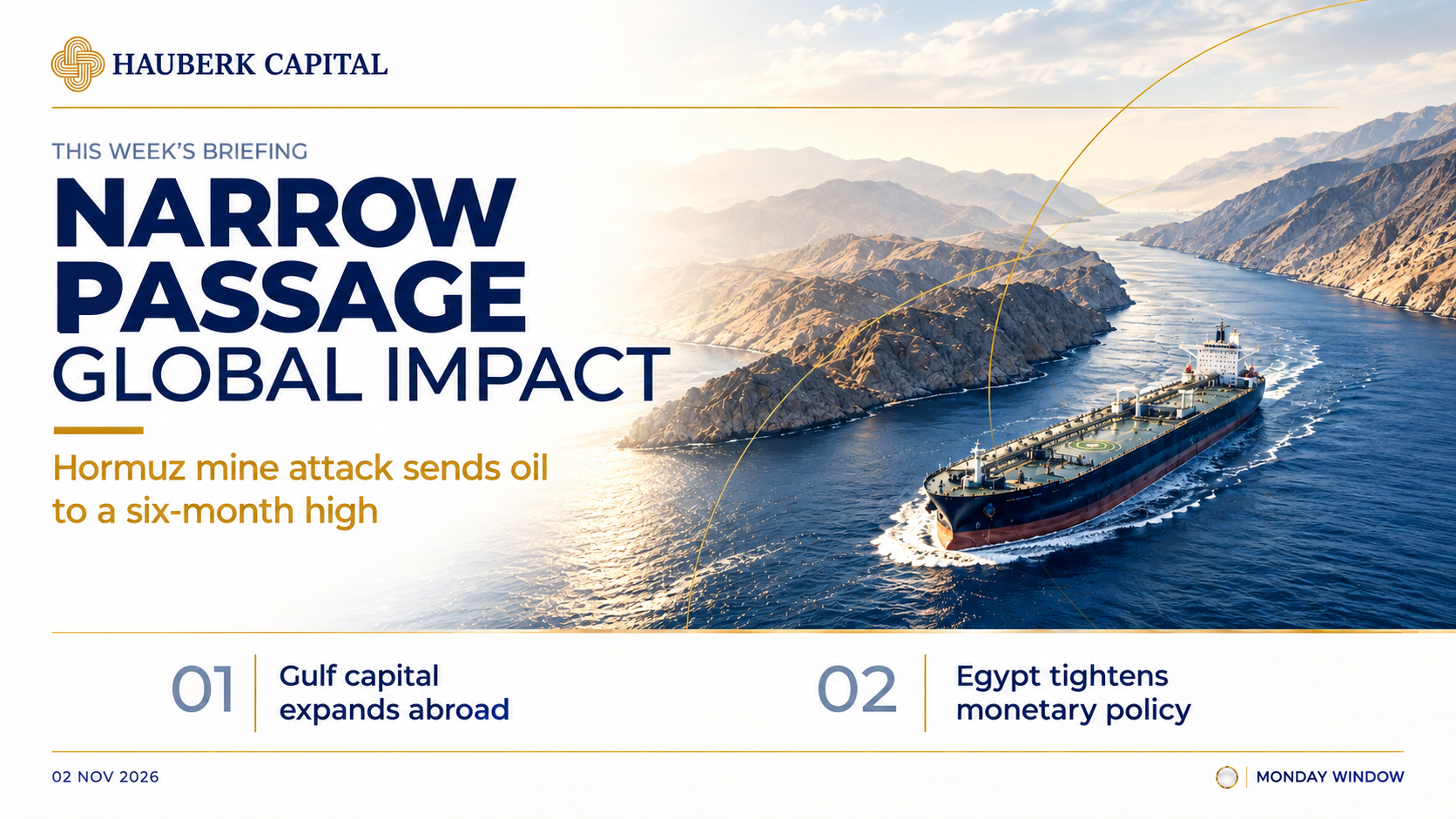
A tanker attack and renewed strikes on Saudi infrastructure pushed Brent above $117 a barrel, while OPEC+ held December output targets, Abu Dhabi deepened global investment links and Egypt combined a rate increase with a landmark bank flotation.
Coverage period: 26 October–1 November 2026
The completed week sharpened the contrast between physical risk in the Gulf and continued institutional capital deployment. A tanker was disabled temporarily in the Strait of Hormuz after explosive devices were attached to its hull, while Yemen’s Houthis claimed further attacks on Saudi oil facilities, pumping stations and airports. Saudi confirmation was not available for several of those claims, but the combination of maritime incidents and continuing missile interceptions kept the risk premium embedded in energy, freight and insurance markets. [Reuters, 26 and 30 October 2026]
Brent crude settled at $117.64 a barrel on 30 October, its highest close since late April, and gained 13.6% during the month. The price move is important for MENA investors because it reflects constrained deliverability and security risk rather than a straightforward improvement in regional production volumes. Higher benchmark prices can coexist with lower realised exports, more expensive insurance and weaker operating conditions for transport, aviation, industry and consumer businesses. [Reuters, 30 October 2026]
Capital activity nevertheless continued. Apollo agreed to acquire a minority interest in Mubadala Capital, while Apollo and other strategic investors are expected to commit an aggregate $5 billion to its strategies. The UAE also signed a comprehensive economic partnership agreement with Canada. In Egypt, the central bank raised policy rates by 100 basis points and Banque du Caire completed a EGP36.37 billion secondary offering after strong institutional and retail demand. [Apollo, 26 October 2026]
Reported development: Maritime sources said two limpet mines were attached to a tanker about 25 nautical miles northeast of Khasab, Oman. The devices caused an engine-room fire and temporarily disabled the vessel. The crew was safe, the fire was extinguished and no environmental damage was reported. Responsibility had not been established. The incident was described as the first successful use of such devices in the strait since the current war began. [Reuters, 30 October 2026]
Reported development: On 26 October, the Houthis said they had targeted Saudi East–West pipeline pumping stations and King Khalid International Airport. Saudi Arabia did not immediately confirm those claims. The Saudi-led coalition separately said it had intercepted a missile directed towards Riyadh and destroyed launch infrastructure in Yemen. The fighting places pressure on both Hormuz and the Red Sea alternatives that Gulf contingency planning has historically treated as separate routes. [Reuters, 26 October 2026]
Hauberk analysis: The investable question is no longer simply whether oil rises when Gulf infrastructure is threatened. Investors need to identify who can deliver contracted volumes, who absorbs additional freight and insurance costs, and which supposedly alternative routes share the same security, power, data or personnel dependencies.
Confirmed development: Saudi Arabia, Russia, Iraq, Kuwait, Kazakhstan, Algeria and Oman decided on 1 November to maintain their September 2026 required production levels for December. They reiterated their commitment to full conformity with the Declaration of Cooperation and will meet again on 29 November. [OPEC, 1 November 2026]
Hauberk analysis: Headline quotas are becoming a weaker guide to cash flow when vessels, terminals, pipelines and insurance determine realised exports. Energy exposure should be assessed across the full chain from production to collection of sale proceeds.
Confirmed development: Apollo will take a minority equity stake in Mubadala Capital. Apollo and additional strategic investors joining as minority shareholders are expected to commit an aggregate $5 billion to Mubadala Capital strategies at the initial close. Mubadala Capital manages more than $60 billion across five alternative-investment strategies, will retain independent governance and is expected to close the transaction in the fourth quarter, subject to legal and regulatory approvals. [Apollo and Mubadala Capital, 26 October 2026]
Financial terms and Apollo’s exact ownership percentage were not disclosed officially. Reuters cited a person familiar with the transaction as saying the interest was close to 10%; that figure should therefore be treated as reported rather than confirmed. The strategic importance lies in combining permanent ownership alignment with capital commitments to investment products. [Reuters, 26 October 2026]
Hauberk analysis: Abu Dhabi is moving beyond acting solely as a limited partner in external funds. It is scaling locally anchored managers that can attract third-party capital, distribute strategies globally and participate in the economics of asset management itself. Family offices should distinguish access to the manager’s corporate growth from exposure to the underlying funds, because governance, liquidity and return drivers differ.
Confirmed development: Canada and the UAE signed a Comprehensive Economic Partnership Agreement on 27 October. Canada said the agreement would ultimately reduce or eliminate tariffs on more than 99% of current Canadian exports to the UAE, address non-tariff barriers and improve access across agriculture, industrial equipment, aerospace, engineering and environmental services. Ratification is still required and entry into force is expected in 2027. [Government of Canada, 27 October 2026]
UAE data showed bilateral non-oil trade of approximately C$2.85 billion in the first half of 2026, 19% higher than a year earlier. The UAE government estimates that the agreement could add $8.7 billion to UAE GDP and increase UAE exports to Canada by $11.8 billion by 2033. These are forward-looking government estimates, not realised outcomes. [WAM, 28 October 2026]
Confirmed development: On 29 October, the Central Bank of Egypt raised its deposit, lending and main-operation rates by 100 basis points to 20.0%, 21.0% and 20.5%, respectively. Annual headline inflation eased to 13.9% in September, but the central bank cited imported inflation, energy and agricultural prices, tighter global financial conditions and the prolonged regional conflict as reasons for a more restrictive stance. [Central Bank of Egypt, 29 October 2026]
The CBE estimated third-quarter real growth at about 4.7%, broadly matching the second quarter, while maintaining a target of 7% plus or minus two percentage points for average inflation in the fourth quarter of 2027. The decision increases the cost of borrowing and refinancing even as economic activity remains relatively resilient. [Central Bank of Egypt, 29 October 2026]
Confirmed transaction: Banque du Caire priced its IPO at EGP5.30 per share, the top of the announced range. The 45% secondary sale comprised approximately 6.86 billion shares and generated EGP36.37 billion, or about $658 million, for the selling shareholder. The private tranche was covered six times overall, and the retail tranche was reported to have been covered more than 27 times. Trading is expected to begin on 2 November, subject to completion of the required procedures. [Banque du Caire announcement, 26 October 2026]
Hauberk analysis: Strong subscription demand supports the state-asset-sale programme and capital-market depth, but it does not guarantee post-listing performance. Investors should assess asset quality, margins, capital adequacy, state influence, valuation and the effects of high interest rates rather than treating oversubscription as a substitute for underwriting.
Confirmed development: The Central Bank of Jordan kept policy rates unchanged on 29 October. Foreign reserves stood at approximately $28.5 billion at the end of September, covering more than nine months of imports, while inflation averaged 2.26% during the first nine months of 2026. Jordan’s decision contrasts with Egypt’s tightening and reflects different currency, inflation and external-balance conditions. [Central Bank of Jordan, 29 October 2026]
Jordan’s cabinet also approved incentives for satellite-communications investments exceeding $10 million, subject to infrastructure requirements including at least six gateway earth stations and points of presence. The objective is to add connectivity routes that complement terrestrial and submarine cables and improve continuity for regional data traffic. A national circular-economy roadmap through 2050 was approved at the same meeting. [Jordanian Prime Ministry, 28 October 2026]
This week reinforces three practical conclusions. First, high oil prices should not be read as a uniform positive signal for Gulf assets. The same disruption supporting oil can raise insurance, freight, security and financing costs, reduce physical volumes and weaken travel confidence. Portfolio analysis should therefore separate commodity-price exposure from delivery-chain exposure.
Second, the Apollo–Mubadala Capital transaction and the UAE–Canada agreement show that Gulf institutions continue to internationalise capital even during regional stress. Wealth owners should distinguish corporate ownership in asset managers, commitments to underlying strategies and direct project exposure; each has different liquidity, governance and valuation characteristics.
For businesses, investors and family offices, the immediate priority is to map the complete route from asset to cash: production, transport, insurance, settlement, banking and delegated decision authority. Resilience should be tested as an operating capability, not accepted as a label attached to an alternative route or jurisdiction.
About Hauberk Capital: Hauberk Capital provides strategic perspectives focused on capital preservation, long-term wealth management and the evolving economic landscape of the Middle East and North Africa.
This release is provided solely for informational and educational purposes. It does not constitute investment, legal or tax advice, an offer, or a recommendation to undertake any transaction. Readers should obtain appropriate professional advice and review the relevant legal and financial documentation before making decisions.
Hauberk Disclaimer: This material is provided for general information and discussion purposes only. It does not constitute investment advice, an offer, or a recommendation to buy or sell any financial instrument. Investors should obtain appropriate professional advice based on their individual circumstances.
