Middle East exports moved above pre-war levels, yet tanker and insurance costs remained exceptional as Saudi-Houthi fighting pushed oil higher and triggered sharp regional market losses.
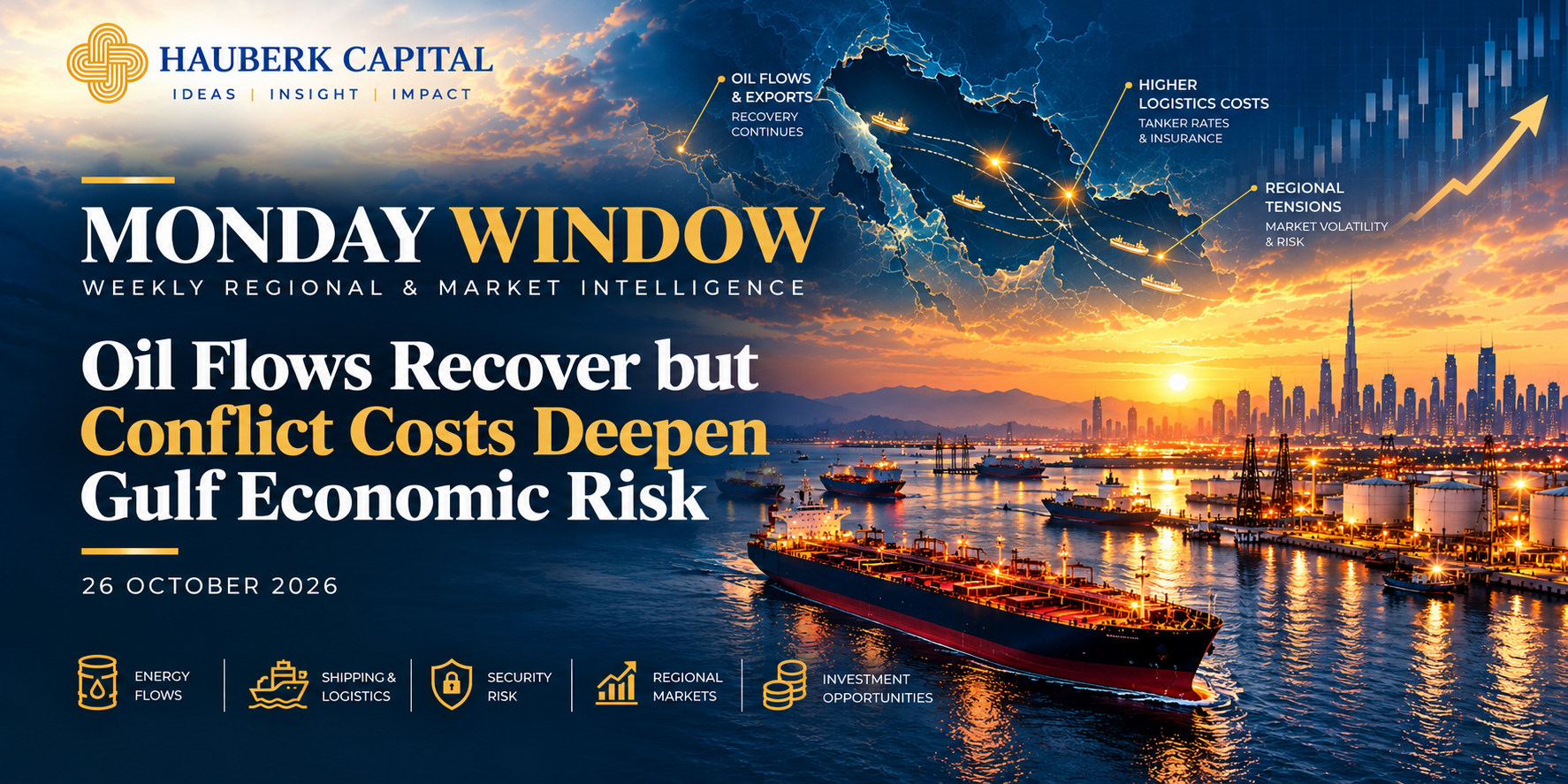
Middle East exports moved above pre-war levels, yet tanker and insurance costs remained exceptional as Saudi-Houthi fighting pushed oil higher and triggered sharp regional market losses.
25 October 2026 | Coverage period 19–25 October 2026
The region ended the week with an increasingly difficult economic contradiction. Gulf oil exports recovered strongly, but the system delivering those barrels remained dependent on naval protection, elevated insurance, expensive freight and altered commercial terms. Brent closed at $116.72 a barrel on 23 October as attacks on Saudi infrastructure and commercial shipping renewed supply fears. (Reuters — Gulf oil flows and logistics costs, 22 October 2026; Reuters — Oil-market close, 23 October 2026)
Saudi Arabia’s benchmark fell 2.7% on 25 October and Egypt’s EGX30 dropped 3.6%. Against the security deterioration, the UAE advanced a major investment programme with Greece and announced Dubai’s first IPO of 2026. (Reuters — Gulf and Egyptian markets, 25 October 2026; Abu Dhabi Media Office — UAE–Greece Strategic Forum, 22 October 2026; Emirates News Agency — DIP Holding IPO, 19 October 2026)
Reported development: Kpler data cited by Reuters showed Middle East crude exports averaging 17.3 million barrels a day in October, above the 16.9 million pre-war average. Hormuz traffic recovered to 11.7 million barrels a day and Saudi exports from Yanbu averaged three million. (Reuters — Gulf oil flows and logistics costs, 22 October 2026)
Yet tanker rates from the Middle East to China were near $1.4 million a day—more than twelve times pre-war levels—and insurance costs had risen to about 10% of cargo value from 3%. Aramco and ADNOC had also begun selling some cargoes on a delivered basis, assuming more transport responsibility. (Reuters — Gulf oil flows and logistics costs, 22 October 2026)
Confirmed market development: Brent settled at $116.72 on 23 October, up 6% for the week, after intensified Houthi attacks and an oil spill reported off the UAE coast. The rise highlighted the gap between available supply and confidence in reliable delivery. (Reuters — Oil-market close, 23 October 2026)
Reported development: Saudi air defences intercepted drones and missiles over Riyadh and southern areas on 25 October after the Houthis said they had targeted oil facilities and airports. TASI closed 2.7% lower, its worst session in 18 months, while Egypt’s EGX30 lost 3.6%, its largest one-day decline since June 2025. Higher oil prices can therefore coexist with weaker valuations when investors price physical damage, operating costs and uncertainty. (Reuters — Gulf and Egyptian markets, 25 October 2026)
Confirmed development: On 22 October, the UAE and Greece announced 18 agreements and partnerships valued at EUR 12.75 billion across technology, energy, logistics, healthcare and food security. The UAE separately announced its intention to invest an additional EUR 15 billion through their joint initiative. (Abu Dhabi Media Office — UAE–Greece Strategic Forum, 22 October 2026; Abu Dhabi Media Office — Additional investment in Greece, 22 October 2026)
On 19 October, DIP Holding announced plans to float 20% of its capital on the Dubai Financial Market. The secondary offering comprises approximately 1.735 billion existing shares sold by Dubai Investments; DIP Holding will receive no proceeds. Subscription is scheduled for 27 October–3 November. As the UAE’s first IPO of 2026, it will test demand after months of disruption. (Emirates News Agency — DIP Holding IPO, 19 October 2026)
Confirmed regulatory development: On 21 October, Egypt’s Financial Regulatory Authority approved standard contracts between brokers and securities borrowers under the new short-selling framework. They define responsibilities, collateral management and position-closing procedures. The mechanism may improve liquidity and hedging, but it also creates borrowing, collateral and settlement risks requiring internal controls beyond the model contract. (Egyptian Financial Regulatory Authority — Model short-selling contracts, 21 October 2026)
Physical volume is no longer an adequate measure of normality. Oil may be moving, but military protection, insurance, freight and revised sales terms redistribute risk across producers, refiners, shipping companies and consumers.
Investors, businesses and family offices should stress-test both higher hydrocarbon income and simultaneous pressure on transport, aviation, construction, insurance and working capital. New transactions should be assessed through funded commitments, cash-flow quality, governance and realistic exit conditions rather than headline scale.
About Hauberk Capital: Hauberk Capital provides strategic perspectives on capital preservation and long-term wealth management across the MENA region.
This release is provided for informational and educational purposes only. It does not constitute investment, legal or tax advice, or a recommendation to undertake any transaction.
Hauberk Disclaimer: This material is provided for general information and discussion purposes only. It does not constitute investment advice, an offer, or a recommendation to buy or sell any financial instrument. Investors should obtain appropriate professional advice based on their individual circumstances.
